News Release
One Year In, SVU’s Sport Performance Major Builds on a Historic Launch
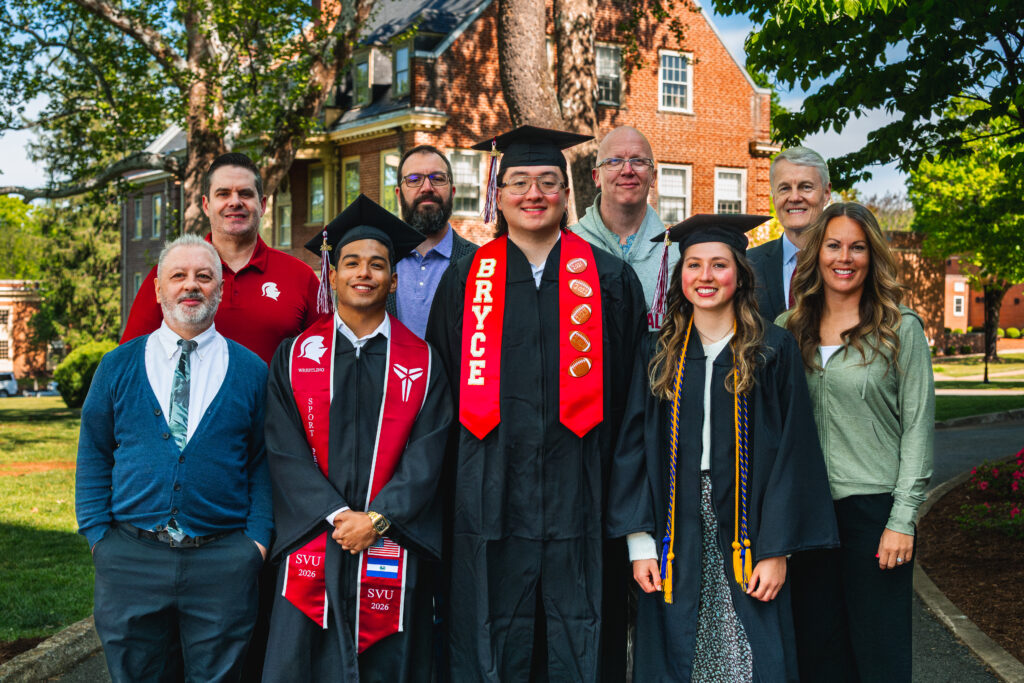
Rear left to right: Andy Pace (physical conditioning), Alan Whitehead (sports psychology), Jeff Batis (Excellence in Sport and Life), John Armstrong (philosophy of sport)
When Southern Virginia University unveiled the Sport Performance major in the fall of 2025, it initiated a movement within higher education — one built on the idea that athletic competition can be at the center of a college education, not on its sidelines. One year later, founding program coordinator and professor of philosophy Dr. John Armstrong says the program is delivering on its promise — and universities around the country are looking to SVU to show the way.
That movement, it turns out, is well-founded. After a full year in the classroom, Armstrong reports that the program’s curriculum and learning goals are performing exactly as designed, with only minor refinements on the horizon.
When Armstrong taught Excellence in Sport and Life, the program’s introductory course, in its first semester, student enrollment packed one of the university’s largest classrooms. This spring he was joined by professor of psychology Dr. Jeff Batis, who taught a second section — a sign of the program’s early growth. “The faculty and students at Southern Virginia University offer a blend of academic and athletic experiences that makes our program shine,” said Batis.
The program serves students interested in coaching, sports management, and exercise science, as well as other professional tracks such as business management, medicine, and law. “Some students may not want to go into a sport-related career,” said Armstrong. “They simply want to reflect during their college years on what they are learning as athletes.”
Five core learning goals drive the program. The first, improved athleticism, grounds the major in the reality that performance in a sport is at the curriculum’s heart. Students learn the science of expertise development and apply it to their own athletic skill set as they participate in at least two seasons of competitive sport. Second, students learn about proper nutrition and how to adhere to a healthy diet, understanding that disciplined habits off the field are inseparable from excellence on it.
The remaining three goals push students into deeper intellectual and moral territory. Students in the program learn to identify the cardinal virtues — courage, temperance, justice, and wisdom — and to exercise them in the heat of competition and in their relationships with teammates, coaches, and officials. They are also trained to argue reasonably on philosophical issues in sport, a skill sharpened through a 10-page paper defending a philosophical position and responding to objections. This year, students chose to write on such questions as whether professional athletes should be allowed to use performance enhancing drugs, whether winning is the most important goal in sport, whether pitch-framing in baseball is morally acceptable, and whether NIL and the transfer portal have dehumanized student-athletes and undermined the virtues that should be part of sport.
The program’s culminating goal is the exercise of leadership in sport to promote social well-being. In the capstone seminar, students discuss principles of Christlike leadership and execute an individualized leadership project. This year’s projects included training volunteers of a local youth sports league on best practices in coaching youth sports, coaching student-athletes on one of the university’s varsity teams, and developing student-assistant coaches into skilled members of the football coaching staff. The program does not want students simply to be good athletes. It wants them to use sport as a vehicle for strengthening relationships and communities.
“The program develops the competencies that employers are looking for,” said Armstrong. “These include pro-actively developing one’s skills, communicating well under pressure, critically analyzing data to make sound decisions, leading through example, being a dependable team member, and representing one’s company with dignity and professionalism.”
The data backs up the approach. Researchers at Harvard Business School and the National Bureau of Economic Research compared the careers of more than 400,000 Ivy League graduates and found that, on average, varsity athletes reached more senior positions and earned more money than their non-athlete classmates despite entering college with modestly lower academic qualifications.
A survey by Ernst & Young found that 90 percent of senior female managers and 96 percent of female C-suite executives at large global companies had played sports in college or before. The numbers reinforce what Armstrong and his colleagues have built the program around — that the discipline of sport produces leaders.
This year’s three graduates, the program’s first, all have job offers in the sports industry.
As SVU’s program enters its second year, Armstrong is watching a field he helped create begin to grow. Two universities in Kentucky are launching similar programs this fall, and many other colleges and universities are studying SVU’s model closely. That growth is reflected on campus, too. The program is already the university’s fifth largest and could be the second largest a year from now.
“The Sport Performance program helps athletes understand the value of what they are doing,” said Armstrong. “Competing in a sport can be good and beautiful in its own right and have benefits down the road.”
For prospective students considering SVU’s Sport Performance major, Armstrong’s message is straightforward: “If you are interested in becoming a better athlete, thinking philosophically about the nature and value of sport, and cultivating your ability to lead others, then SVU’s program is for you.”